Shadows of History: My parents' spiritual bookstore by the Brussels Grand Place
A Literary America250: Marcia Davenport's My Brother's Keeper
Given all the turmoil in the world it’s easy to feel at times, amidst the highs and lows, that there isn’t much to celebrate. I’m surely not alone when I say that I didn’t anticipate America’s 250th anniversary to feel so bleak, disappointing, and even revolting in (political) parts.
Yet as a Christian with Holy Land ties who strives to (reasonably) look on the brighter side, I wanted to use some of this–undeniably trying and strange–commemorative time by giving attention to American literature of all kinds.
As a bilingual novelist and book lover I’m constantly adding titles to my never-ending pile, but this personalized endeavor reminded me how nice it can be to narrow it down, too. My list initially began with mostly history titles on the American Revolution and American classics, but that soon changed. Not that I no longer want to read these books, but as usual, time and priorities are constraints. The fact is that there will always be more material than you can get to.
So instead I went with a more intuitive approach. That said, some titles that I’ve enjoyed and fit this “more traditional” reading bill include: Philbrick’s Mayflower, McCullough’s 1776, Ellis’s Washington: His Excellency, The Wisdom of the Native Americans (ed. Nerburn), and Booker T. Washington’s Up From Slavery, to name a very few.
As such, my changed plan formed around three main goals: 1) to read American titles of any era; 2) from my stash as much as possible; and 3) from previously unread authors as fitting. Though length was a lesser factor, I was soon gravitating to shorter titles, too, in part to help me cover more ground.
The result so far has not only pleasantly surprised me, but yielded favorites in the best spontaneous way. Though the list does not entail all titles read for this challenge, but chiefly the most memorable, it’s still time well spent when even “lesser” reads offer learning experiences.
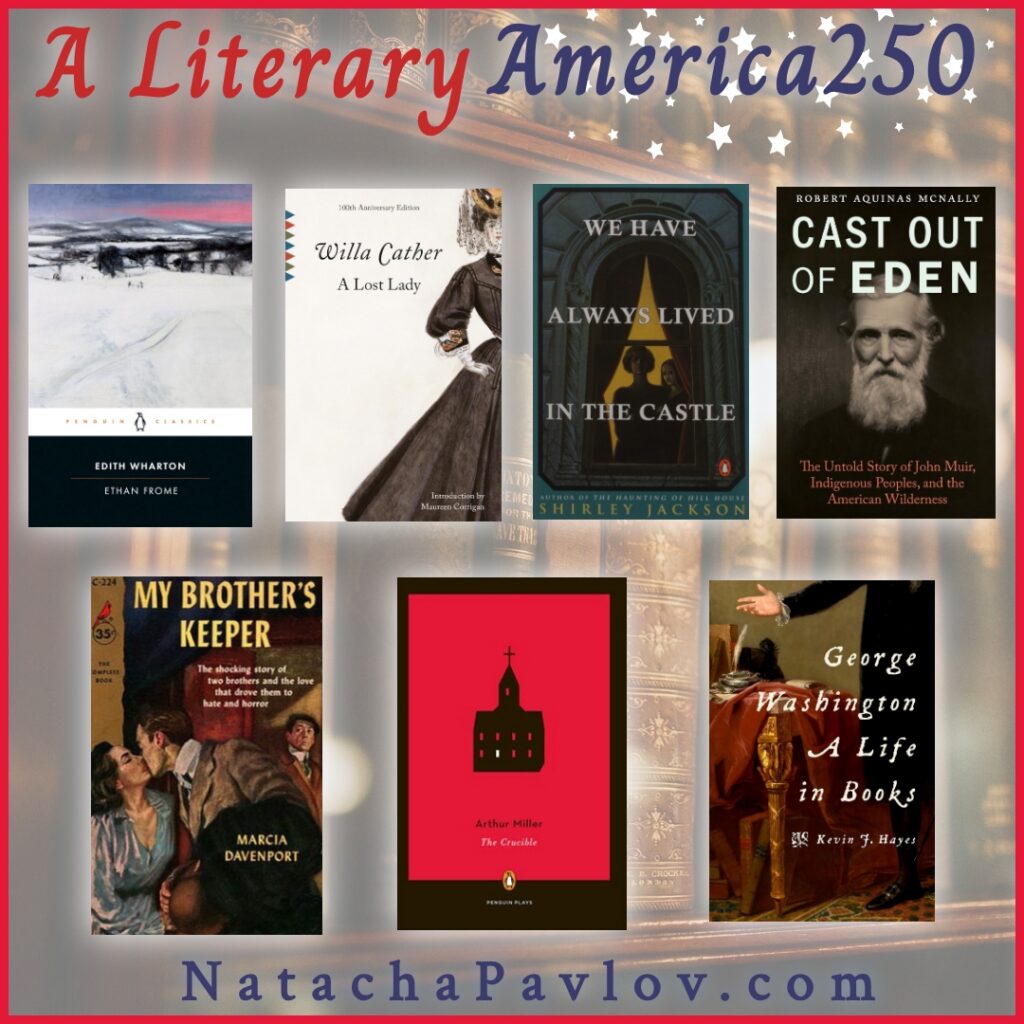
The top list, in the order read:
Ethan Frome by Edith Wharton (1911)
“He seemed a part of the mute melancholy landscape, an incarnation of its frozen woe, with all that was warm and sentient in him fast bound below the surface; but there was nothing unfriendly in his silence.”
Having already read several titles by Wharton I was already a fan of her gifted pen. I’ve pretty much come to the point where I’d read anything by her because she’s that perceptive of a writer. Once again, the concise yet memorable Ethan Frome did not disappoint, and maybe even surprised me a bit more in that it departs from her usual affluent New York society setting, which only goes to show yet again her range and talent for poignant storytelling.
A Lost Lady by Willa Cather (1923)
“He liked being alone with the old things that had seemed so beautiful to him in his childhood.”
A new one for me all around, and while I disrupted my rule of “my stash” by beginning with this library find, this brief read was a delight. I love the liminal feel of late 19th century Victorian-Second Industrial Age that blurs the line of old and new. I’ve been gravitating to these kinds of stories lately and it can make a sort of mirror to our own ongoing changes. This read only makes me more poised for Cather’s Death Comes for the Archbishop from my collection.
We Have Always Lived in the Castle by Shirley Jackson (1962)
“‘I cannot work in here if that young man is going to talk all the time,’ Uncle Julian said. ‘Constance, tell him he must be quiet for a little while.'”
As an author I’d already read, this was most surprising in that I was basically ready to pass on more of Jackson’s work. While the unsettling The Lottery and Hangsaman were memorable, I was most disappointed by The Haunting of Hill House, which I’d had high hopes for. While this mixed bag left me unsure, I’m so glad I went with my random nudge to check it out, fueled in part by its brief page count. I can definitely see why some consider it her best–and my fault for letting the mediocre film version deter me… when it should’ve been where I’d started!
Cast Out of Eden: The Untold Story of John Muir, Indigenous Peoples, and the American Wilderness by Robert Aquinas McNally (2024)
“Somehow,” he wrote, “they seemed to have no right place in the landscape.”
I beg your fuckin pardon?! Talk about such a harrowingly enlightening read. I only knew the vague basics about John Muir, and some of my earliest (90s) memories of arriving in northern California involve trekking through the amazingly lovely Muir Woods. (Likewise, one of my earliest English-language books was that of the Muir Woods by James M. Morley that I surely got at the gift shop and whose photography caught my attention, because–given the temporary language barrier–I doubt I could fully read it then.) McNally’s account tells the neglected part of Muir’s story whose mystical-wilderness views excluded Native Americans. Sobering and necessary reading on California and national history.
My Brother’s Keeper by Marcia Davenport (1954)
This year’s winner! Read about this haunting and strangely forgotten historical fiction gem that I discovered via its recent French Folio pocket edition.
The Crucible by Arthur Miller (1953)
Parris: Why could there not have been poppets hid where no one ever saw them?
Proctor, furious: There might also be a dragon with five legs in my house, but no one has ever seen it.
This title instantly recalls my high school years, when it was required reading for many of my peers. (It wasn’t for me, unlike Hawthorne’s The Scarlet Letter, which I enjoyed). While I already knew the film with Daniel Day-Lewis and Winona Ryder (whose screenplay I didn’t know was also authored by Miller), this was a memorable page-turner that offers a creative take on the Salem Witch trials. I re-watched the movie after reading and got tearful at the movingly fitting addition of the Lord’s Prayer.
George Washington: A Life in Books by Kevin J. Hayes (2017)
“‘The unfortunate condition of the persons, whose labor in part I employed,’ Washington admitted, ‘has been the only unavoidable subject of regret.'”
There’s clearly no shortage of books on Washington, which can be daunting on its own. Until I get to Chernow’s massive biography, this title surfaced as I pondered what he might’ve read (something I often wonder about with historical figures). This was a fascinating journey through the kinds of books and other various reading materials that accompanied Washington’s adventurous life. I loved seeing that a translated French title was in his collection, and one which caught my eye while I wrote my layered Gothic novel on Louis XV. It also amusingly resonated that he corrected spelling mistakes/misprints and made occasional comments–both of which I do with my own books.
My reading challenge is ongoing so the list may be incomplete and to be updated as fitting. And yet, if I don’t find others to add, I already consider this endeavor a success. I’m also noticing that the fiction titles are all from the 20th century so far, which was not intentional. These will also be going into my favorites on Bookshop too, if you’d like to explore eclectic beloved titles and support indie bookstores.
Cheers to the enduring gifts of literature!